
How to Use Your Loyalty Program to Win BFCM Without Deeper Discounts
Every October, the same conversation happens inside ecommerce brands. Someone points out that a competitor is planning 30% off sitewide. Someone else worries that 20% won’t be enough to stand out. And by the time Black Friday arrives, the brand has committed to a discount deeper than last year’s, on margin it can’t really afford, to shoppers who may never come back.
There is a better lever, and most mid-market and enterprise brands already own it: the loyalty program.
Used well, loyalty lets you give real value during Black Friday and Cyber Monday without handing the same discount to every visitor. You can reward your best customers first, give shoppers a reason to buy from you instead of whoever is cheapest, and turn the flood of first-time holiday buyers into members you can bring back in January.
This guide covers eight loyalty tactics you can set up in the next six weeks, how to model their real cost, and a week-by-week timeline that runs through Cyber Monday on November 30, 2026.
Why deeper discounts backfire
Sitewide discounts are blunt. They have three problems that compound every year.
They subsidize people who would have bought anyway. Your most loyal customers were likely to order during the holidays regardless. A 30% discount gives them margin they never asked for.
They train customers to wait. When shoppers learn your brand always runs a big November sale, they delay purchases to catch it. Full-price revenue in October and early November suffers.
They attract deal hunters who don’t return. Many BFCM buyers are there for the price, not the brand. Without a plan to re-engage them, they disappear after one order.
A loyalty program flips each of these. Instead of one discount for everyone, you choose who gets what: early access for your best customers, extra points for members, and a clear reason for new buyers to join and come back. The value you give is targeted, and much of it is earned on future purchases rather than taken off today’s order.
8 loyalty tactics for BFCM
1. Give your top tier early access
Early access is the highest-value, lowest-cost perk you can offer. Open your Black Friday sale to top-tier members 24 to 48 hours before the public launch. They get first pick of inventory and bestsellers before they sell out, and you pull revenue forward before your competitors’ sales go live.
Early access also gives non-members a concrete reason to join in the weeks before BFCM. “Join free to shop our sale a day early” is a stronger sign-up message than a generic points pitch.
Tip: Put a hard cutoff on who qualifies (tier status as of a set date) so shoppers can’t game it at the last minute.
2. Offer points multipliers instead of a deeper discount
If your plan was to move from 20% off to 30% off, consider holding at 20% and offering members 3x points instead. For many brands, a multiplier costs far less than an extra 10 points of discount, and the value is only realized when the customer comes back to redeem. That makes the promotion a built-in reason for a second purchase.
Multipliers work best when the math is easy to understand. “Triple points on everything this weekend” beats a tiered chart that shoppers need to decode.
3. Create tier-exclusive offers and gifts with purchase
Not every member needs the same offer. Reserve something special for your highest tiers: a limited gift with purchase, a product bundle not sold publicly, or free expedited shipping during the busiest week of the year. These perks feel exclusive, cost you a known amount per order, and reinforce why the tier is worth reaching.
There is good evidence that this kind of recognition matters more than another round of discounts. The Bond Loyalty Report, one of the longest-running studies of loyalty programs, found that access, such as first looks and front-of-the-line treatment, was the top driver of loyalty in both 2025 and 2026. Customers increasingly care about how a brand recognizes them, not just how much it gives them.
That makes BFCM a natural moment to show your best customers they are seen. Structure your perks so the most desirable ones sit at the top tier, like a full-size product for your VIPs and a travel-size version for mid-tier members. Members then have a reason to spend more to reach or keep that tier, and you never had to cut prices for everyone to get there.
One caution: only offer perks you can sustain. Bond’s 2024 report found that brands that pulled back earning and benefits for their higher-status members saw satisfaction fall by as much as double digits. A tier perk that disappears in January can do more damage than never offering it at all.
4. Send “use your points” reminders before the sale
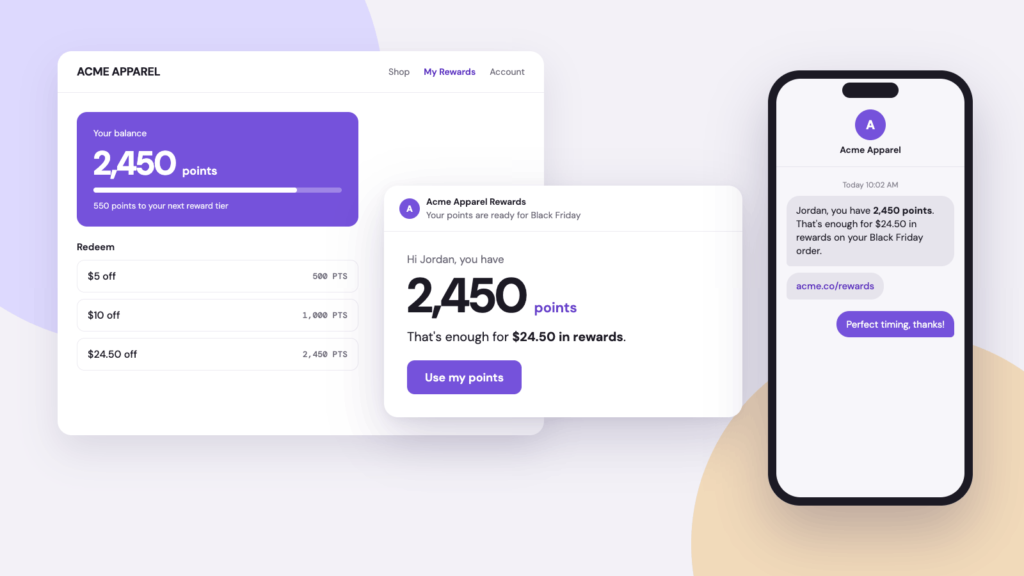
Most programs carry a large pool of members with unredeemed points. Before BFCM, send those members an email and SMS showing their exact balance and what it can buy. A balance reminder is personal, costs nothing to send, and reactivates dormant customers right when they are already planning holiday purchases.
If your program has points expiration, time the reminder for early November and make the deadline clear. Urgency tied to something the customer already owns tends to feel helpful rather than pushy.
5. Reward photo and video reviews on holiday orders
BFCM brings a spike in orders, which means a spike in review opportunities. Offer bonus points for reviews on holiday purchases, with a larger bonus for photos or video. Fresh, visual reviews help convert the shoppers who arrive in December looking for last-minute gifts, and the points bring reviewers back to your store to spend them.
Keep the incentive tied to leaving a review, not to leaving a positive one. That keeps your reviews trustworthy and in line with review platform and FTC guidelines.
6. Boost referral rewards for gifting season
The holidays are when customers are most likely to talk about products with friends and family. Raise your referral reward for November and December, and give both sides something: points for the referrer and a first-order perk for the friend. A referral from a real customer brings in a new buyer who already trusts the brand, which is a better starting point than a deal hunter from a paid ad.
7. Enroll first-time buyers at checkout and after purchase
This is the tactic most brands skip, and it is where much of BFCM’s long-term value is won or lost. A large share of your holiday buyers will be new to you. If they leave without joining your program, you have a much harder time bringing them back.
Make enrollment part of the purchase itself. Show the points they will earn on this order at checkout, enroll them automatically or with one click, and follow up in the post-purchase flow with their balance and what it unlocks. A customer with points sitting in their account has a reason to return in January.
8. Run member-only drops over SMS
SMS is the fastest channel during BFCM week, when inboxes are flooded. Use it for short, member-only moments: a limited product drop, a flash multiplier for three hours, or a restock of a sold-out bestseller. Keeping these offers exclusive to members makes the program feel valuable and gives subscribers a reason to keep SMS turned on after the holidays.
Model the real cost before you launch
Loyalty is not free. Points multipliers and generous perks can quietly create a new margin problem if you don’t run the numbers first.
Here is a simple way to compare options. Say members earn 1 point per $1 spent, and 100 points are worth $1 off. That is a 1% reward rate. A 3x multiplier raises it to 3% of order value, an increase of 2 percentage points over what members already earn. Compare that with moving from 20% to 30% off sitewide, which gives up an extra 10 percentage points on every order, from every shopper, immediately.
Two things make the loyalty option cheaper still. First, not every point gets redeemed, so the realized cost is usually lower than the face value. Second, points are redeemed on a future order, which means the cost is tied to a second purchase you might not otherwise have earned.
The pattern shows up clearly at scale. Across brands on the SiteVibes platform from Thanksgiving through Cyber Monday 2025 (November 27 to December 1), shoppers earned more than 3.2 billion loyalty points and redeemed about 267 million, roughly 12 points earned for every point redeemed. That gap is the “reward, don’t discount” model working as intended: most of the value lands on a future order instead of coming off today’s. It is also why the next step matters, because those unredeemed points become a balance you will carry into January.
Before launching, check these four things:
- Your historical redemption rate, so you can estimate the realized cost of any multiplier.
- Stacking rules. Decide whether multipliers apply on top of sale prices, and whether points can be redeemed on already discounted items during BFCM.
- Low-margin exclusions. Consider excluding gift cards and thin-margin products from multipliers.
- Points liability. Unredeemed points are a financial obligation. Loop in finance before running an aggressive multiplier so there are no surprises at year-end.
Your 6-week BFCM loyalty timeline
If you start in mid-October, you have enough time to set up every tactic above without a last-minute scramble.
| Week | Focus | What to do |
|---|---|---|
| Oct 19 to 25 | Plan | Pick your tactics, model the cost of each, set stacking rules, and get sign-off from finance. |
| Oct 26 to Nov 1 | Build | Configure multipliers, tier-exclusive offers, review bonuses, and referral rewards. Update checkout and post-purchase enrollment. |
| Nov 2 to 8 | Reactivate | Send “use your points” reminders by email and SMS. Launch the boosted referral offer for gifting season. |
| Nov 9 to 15 | Build the list | Announce VIP early access and promote “join free to shop first” across site, email, and social. |
| Nov 16 to 22 | Early access | Lock tier eligibility, open early access to top-tier members, and send the first member-only SMS drop. |
| Nov 23 to 30 | BFCM week | Run multipliers through Cyber Monday (Nov 30), enroll every first-time buyer, and send short member-only SMS moments. |
In December, keep going: send review requests with bonus points on holiday orders, and start the post-purchase flow that brings new members back for a second order in January.
Frequently asked questions
Should I skip discounts entirely on Black Friday?
Not necessarily. Most shoppers expect some kind of offer. The goal is to avoid escalating to a deeper sitewide discount each year and to use loyalty perks to make a moderate offer more compelling.
Are points multipliers better than a percentage discount?
For many brands, yes. A multiplier usually costs less per order, and the value is redeemed on a future purchase. Model it against your own redemption rate before deciding.
When should VIP early access start?
24 to 48 hours before your public sale is typical. It is long enough to feel exclusive and short enough to keep urgency high.
How do I keep BFCM buyers from being one-time customers?
Enroll them in your loyalty program at checkout, show them their points balance after purchase, and give them a clear reason to come back in January.
Make loyalty your BFCM advantage
The brands that win the holidays over the long run aren’t the ones with the deepest discount. They are the ones that use BFCM to reward their best customers and turn new buyers into repeat ones.
SiteVibes brings Loyalty, Reviews, Email and SMS together on one platform, so you can run VIP early access, points multipliers, review bonuses, and member-only SMS drops without stitching tools together. Book a demo to see how it works for your brand before BFCM.
